Text
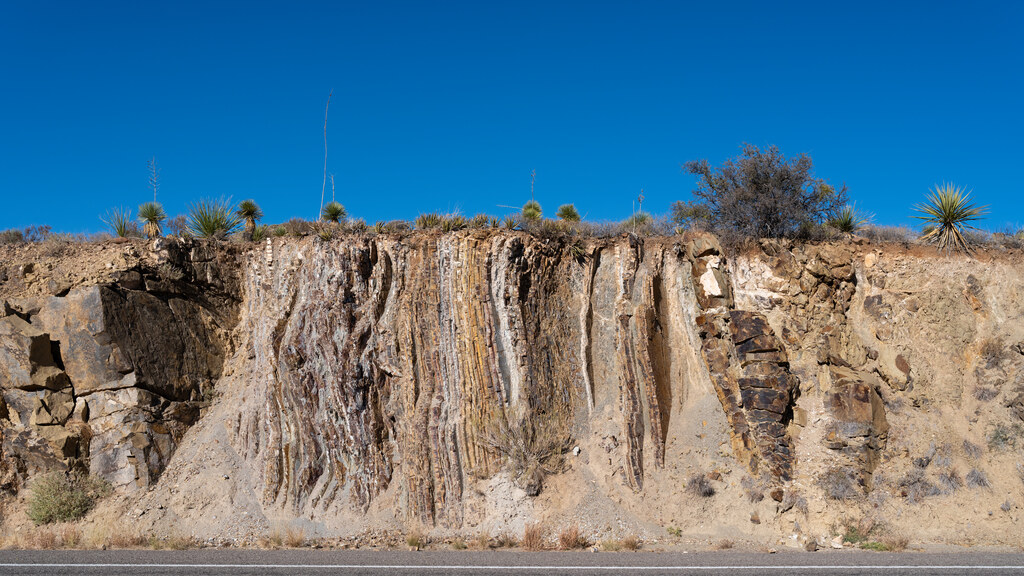
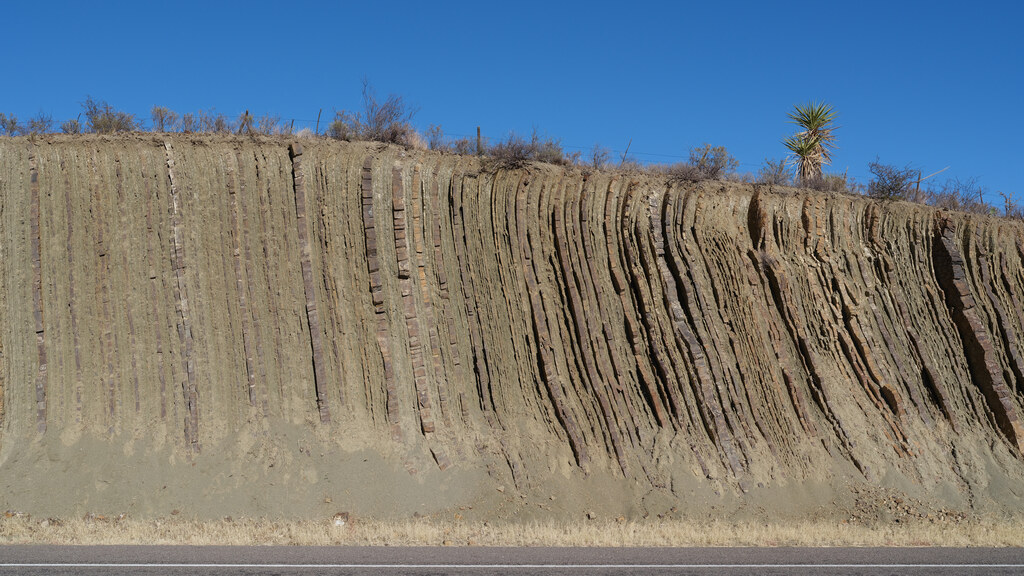
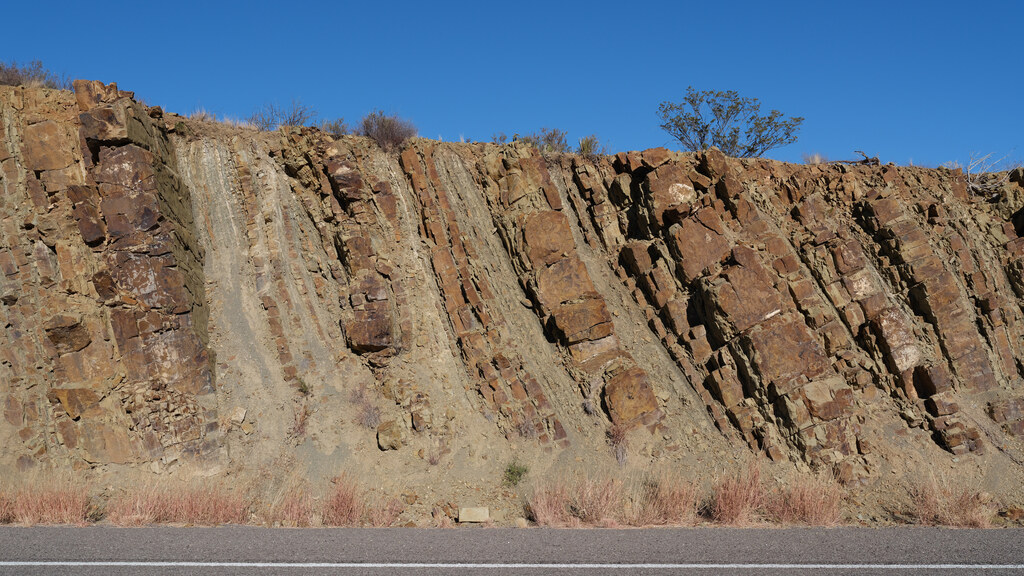
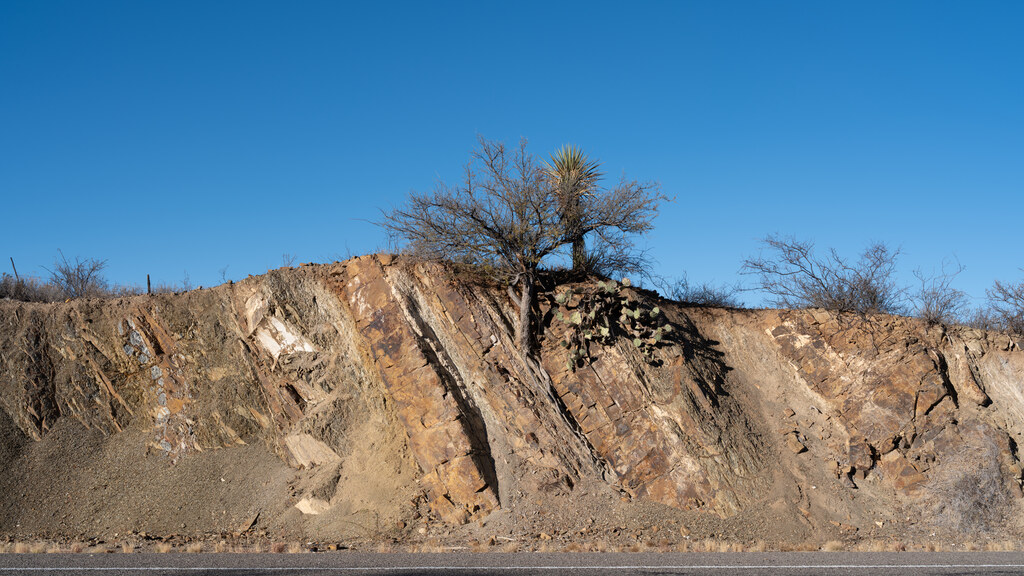
The roadcuts east of Marathon expose part of the Marathon fold-and-thrust belt, the West Texas continuation of the Ouachita orogenic system. The exposed rocks began as sediments in a deep marine basin. Continental collision during the assembly of Pangaea later folded, faulted, and transported those deposits. Near-vertical beds, tight folds, and thrust faults expose the sedimentary cover of a mountain system that once extended far beyond the present outcrops.
Three principal formations preserve different parts of the basin’s history. The Tesnus Formation contains deep-water sandstone and shale with slump structures and sandstone dikes, the Haymond Formation contains thin-bedded sandstone and shale with coarser beds and slumped deposits, and the Dimple Limestone passes from shelf and slope facies into basin deposits of limestone, shale, and chert. Together they record sediment moving from shelf and slope environments into the deep basin before tectonic shortening. Their present juxtaposition reflects sedimentation, burial, faulting, and the removal of part of the normal stratigraphic sequence.
The exposures record two broad stages of deformation. Sand injections, convolute bedding, slumps, and debris flows formed while the sediment remained soft and water-rich. Folding, shearing, boudinage, and northwest-directed thrusting followed after burial and lithification, when continental compression shortened the sedimentary succession.
Structural reconstructions indicate that shortening within parts of the Marathon allochthon locally approached 80 percent. The collision compressed the basin deposits into a thin-skinned fold-and-thrust belt and transported them northwestward. The complete sequence runs from deep-water sedimentation through soft-sediment disturbance, burial, folding, thrusting, erosion, and exhumation.
The Marathon area provides an erosional window into an ancient mountain belt buried beneath younger rocks across much of Texas. A USGS map and report of the eastern Marathon Basin documents nearly horizontal Cretaceous limestone resting unconformably above the steeply deformed Paleozoic strata. The contact records erosion of the original mountains and a gap of roughly 200 million years in the preserved rock record.
References
- Structural style of the Marathon thrust belt, West Texas Reconstructs the thrust belt from field mapping and subsurface data, including northwestward transport and approximately 80 percent shortening within the allochthon.
- The Ouachita System Surveys the exposed and buried Ouachita system across Texas and Oklahoma, including its western extent in the Marathon region.
- Supercontinent Pangea Explains the continental collisions that assembled Pangaea and identifies the Marathon and Ouachita mountains as parts of the collision zone.
- Sedimentary petrology and history of the Haymond Formation (Pennsylvanian), Marathon Basin, Texas Describes the Haymond Formation’s sandstone-and-shale succession, slumped deposits, sedimentary structures, and regional depositional history.
- Geology of the eastern part of the Marathon Basin, Texas Maps and describes the eastern basin’s Carboniferous formations, Cretaceous cover, angular unconformity, and structural geology.