Text
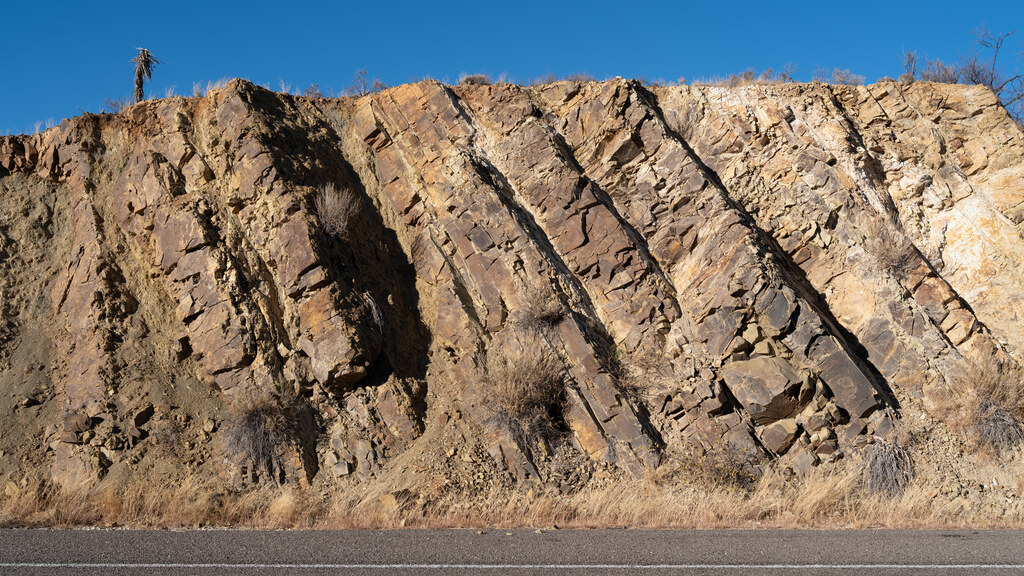
The roadcuts east of Marathon belong to the Marathon fold-and-thrust belt, which deformed sediments deposited in a deep marine basin. Continental collision during the assembly of Pangaea later folded, faulted, and transported those deposits northwestward. The exposures therefore combine structures formed in wet sediment with structures imposed after the sediment had hardened into rock.
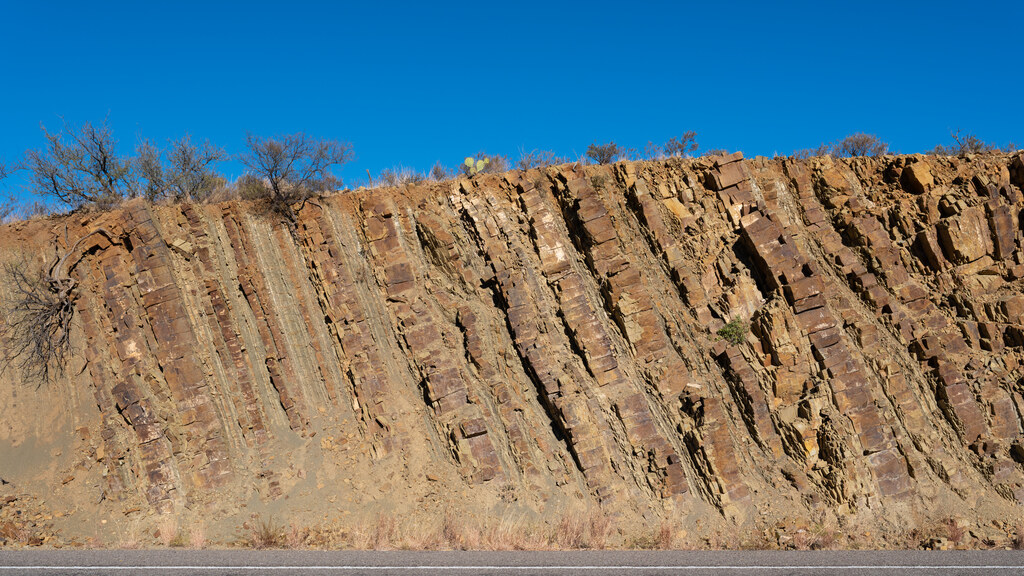
Much of the section consists of steeply inclined or nearly vertical sandstone and shale in the Pennsylvanian Haymond Formation. Turbidity currents carried sediment downslope across the basin floor, producing graded bedding, sole marks, and Bouma sequences. Flute casts and groove casts indicate that many of these currents moved generally westward or northwestward.
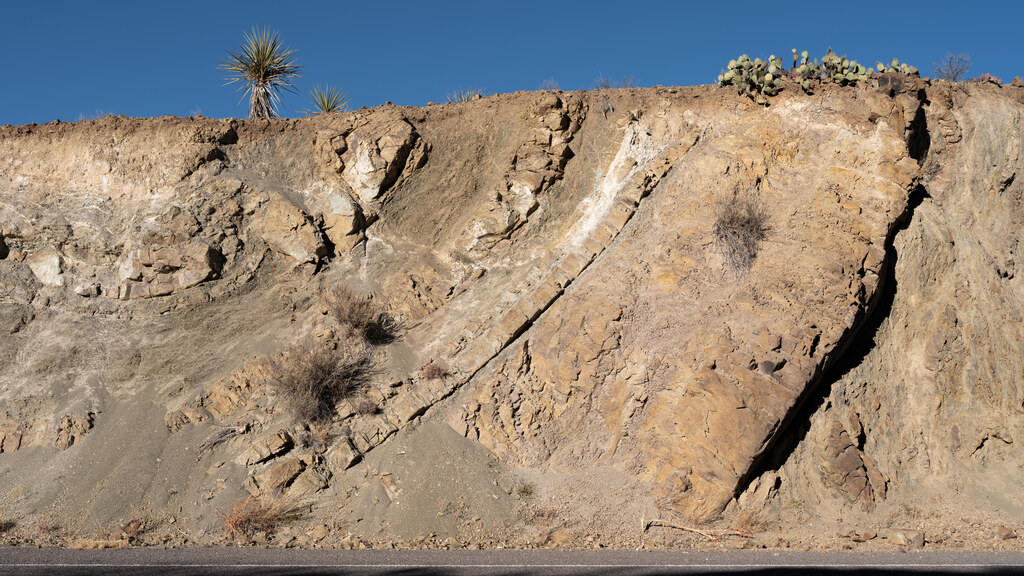
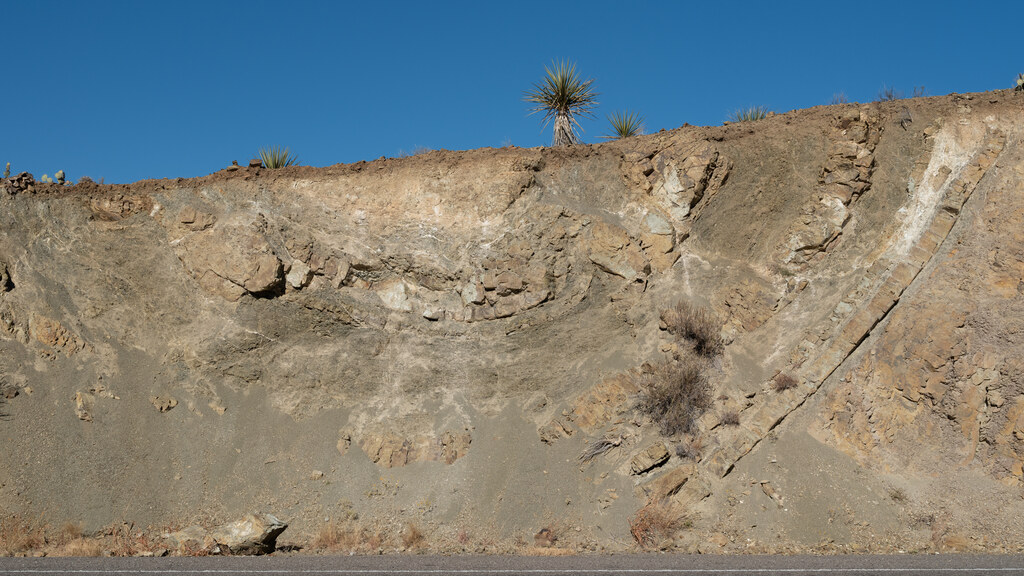
The Haymond thrust fault places older Tesnus Formation rocks over younger Haymond strata. The intervening Dimple Limestone is absent at the contact, indicating that movement along the fault removed or bypassed part of the normal sequence. Broken and folded sandstone, intensely contorted shale, small faults, and boudinage mark the fault zone.
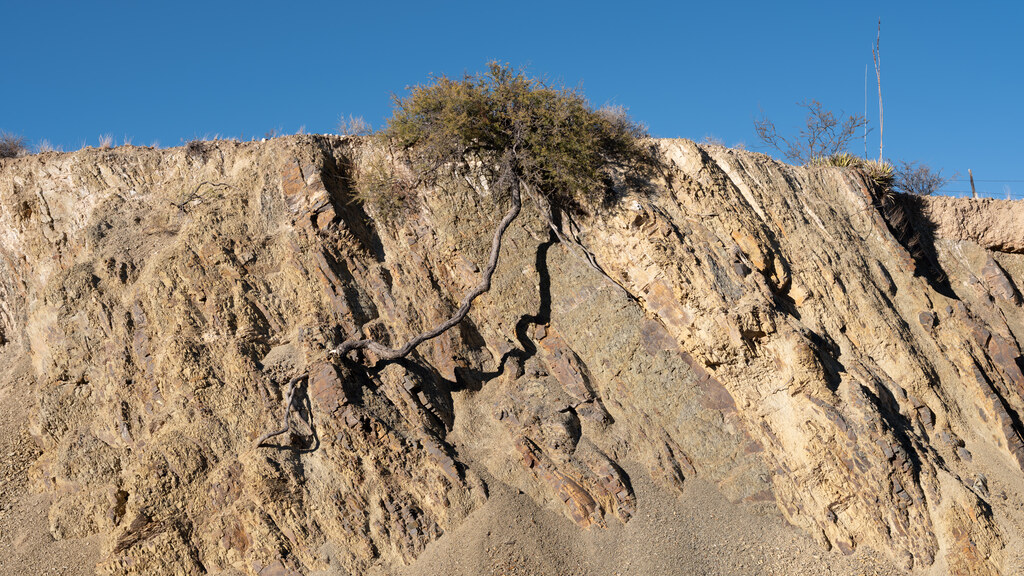
Nearby Tesnus exposures contain tight folds, strongly compressed synclines, pervasive shearing, and additional boudinage. In boudinage, competent sandstone beds stretch and separate into lens-shaped segments within weaker shale. Some zones are deformed enough to conceal subsidiary thrust faults within the formation.
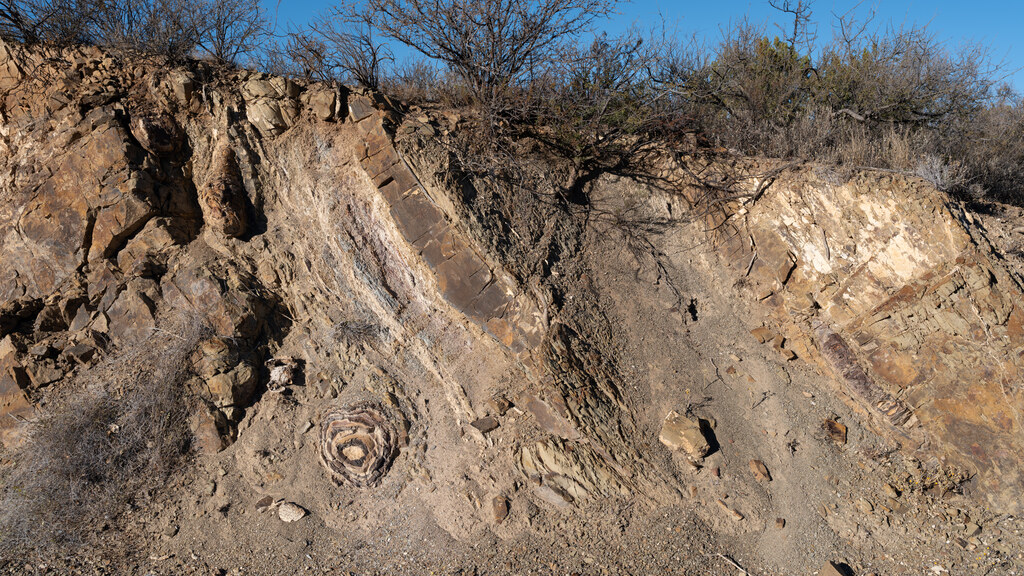
The Tesnus also preserves deformation that predates lithification. Sandstone injected into wet mud forms dikes and sills that cut across bedding, follow bedding planes, or branch through shale. Later folding of some injected bodies suggests that the muddy sediment lost roughly half its thickness during burial and dewatering.
Slumps, mudflows, debris-flow deposits, disrupted siliceous shale, chert, and altered volcanic tuff record repeated failure on an unstable submarine slope. These deposits formed below the influence of ordinary storm waves, where sediment moved downslope and mixed with adjacent material. Their deformation occurred before the regional tectonic compression that later steepened and faulted the section.
The Dimple Limestone records a related deep-water environment. Limestone turbidites carried carbonate debris from a shallower marine shelf into the basin and accumulated among mudstone and black chert. Much of the chert formed from silica derived from sponge spicules, with a smaller contribution from radiolarians. These beds preserve repeated sediment flows from the platform into deeper water.
Distinguishing soft-sediment deformation from tectonic deformation provides the central interpretive problem. Sand injections, convolute bedding, slumps, mudflows, and debris-flow structures formed soon after deposition, while the sediment remained weak and saturated. Near-vertical bedding, tight folds, thrust faults, pervasive shearing, and tectonic boudinage formed later under continental compression.
The structures preserve a chronological sequence rather than one episode of disruption. In compressed form: deep-water sedimentation → submarine slope failure and sediment injection → burial and lithification → continental collision, folding, and thrusting → erosion and exhumation. Reading the roadcuts depends on assigning each structure to its place in that sequence.
The photographs follow changes in the exposure over short distances along the highway. Dense gray lamination gives way to broader rust-colored beds, diagonal fractures, pale folded bands, and heavily disrupted zones. Sparse shrubs and isolated trees provide scale for both the cut faces and the structures within them.
References
- Structural style of the Marathon thrust belt, West Texas Reconstructs the thrust belt from field mapping and subsurface data, including northwestward transport and approximately 80 percent shortening within the allochthon.
- Supercontinent Pangea Explains the continental collisions that assembled Pangaea and identifies the Marathon and Ouachita mountains as parts of the collision zone.
- Sedimentary petrology and history of the Haymond Formation (Pennsylvanian), Marathon Basin, Texas Describes the Haymond Formation’s sandstone-and-shale succession, sedimentary structures, slumped deposits, and regional depositional history.
- Geology of the Marathon Uplift, west Texas Guides the U.S. 90 roadcuts and identifies the Haymond fault zone, boudinaged beds, Tesnus injectites, and evidence for later compaction.
- An outcrop study of clastic-injection structures in the Carboniferous Tesnus Formation, Marathon Basin, Trans-Pecos Texas Examines the form and emplacement of sandstone dikes and sills in the Tesnus Formation.
- Shallow to Deep Water Facies Development in the Dimple Limestone (Lower Pennsylvanian), Marathon Region, Texas Distinguishes shelf, slope, and basin facies in the Dimple Limestone and describes its carbonate turbidites, shale, and spicular chert.